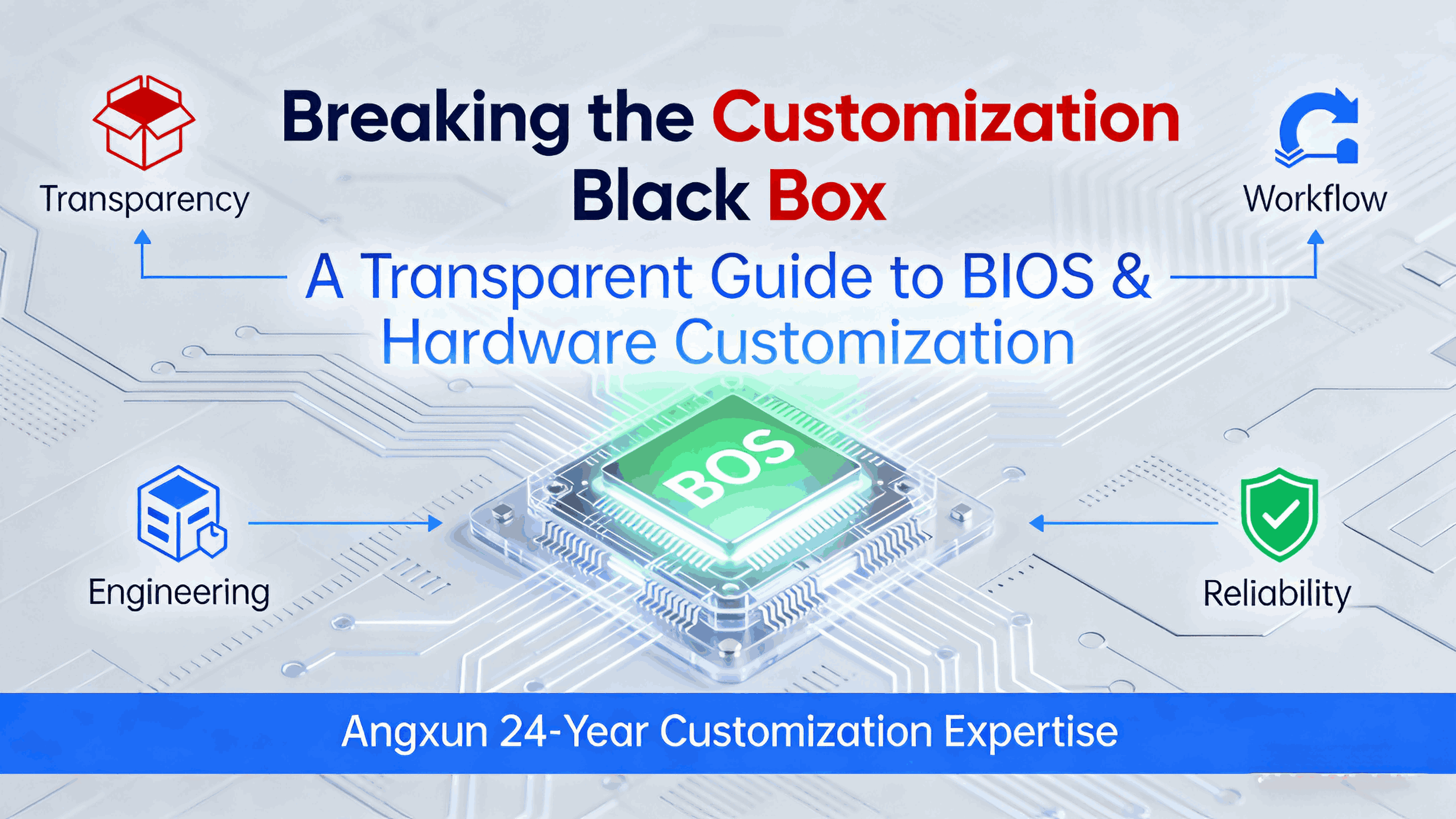
Breaking the “Customization Black Box”
A Transparent Guide to BIOS & Hardware Customization
For many OEM, ODM, and solution providers, the idea of BIOS or hardware customization often feels like stepping into a “black box.” Requirements go in, prototypes come out—but what actually happens in between is rarely explained clearly.
This lack of transparency creates fear:
Will the changes break compatibility? Will the delivery be delayed? Will the firmware remain maintainable? Will production be scalable?
In reality, a well-structured customization process should be predictable, auditable, and aligned with your business goals—not a mystery.
At Shenzhen Angxun Technology, we’ve spent 24 years building a clear, engineering-driven customization methodology that takes you from requirement to mass production with full visibility.
Why Transparency Matters in BIOS & Hardware Customization
1. Prevent misunderstandings and hidden risks
Clear process mapping reduces rework, delays, and compatibility surprises.
2. Improve cross-team communication
When firmware teams, hardware engineers, procurement, and quality teams share the same process map, execution becomes smoother.
3. Protect long-term maintainability
Transparent customizations come with documentation, reproducible builds, and repeatable testing procedures.
4. Increase confidence for large-scale deployments
Enterprises and system integrators need visibility into every phase—from sourcing to BIOS tuning—to ensure reliability and continuity.
A Fully Transparent Customization Workflow
(A framework designed for OEM/ODM customers, industrial clients, and solution providers.)
Below is the Angxun Customization Flow, engineered to ensure control, predictability, and quality across every step:
1. Requirement Definition (R0 Stage)
We begin with a detailed technical intake session covering:
CPU / chipset requirements
Boot behavior, security policies, and BIOS-level features
I/O mapping and GPIO behavior
Compatibility requirements (memory, storage, PCIe, OS, drivers)
Mechanical constraints and thermal expectations
Certification or regulatory needs
Deliverable: Requirements Specification Sheet (RSS)
Purpose: Eliminates ambiguity from day one.
2. Feasibility Study & Engineering Proposal (R1 Stage)
Angxun’s 50+ R&D engineers evaluate:
Electrical and thermal feasibility
BIOS modifiability
Component availability and EOL status
Potential risks and mitigation options
Time-to-prototype and cost structure
Deliverable: Engineering Feasibility Report + BoM Outline
This phase prevents surprises later in production.
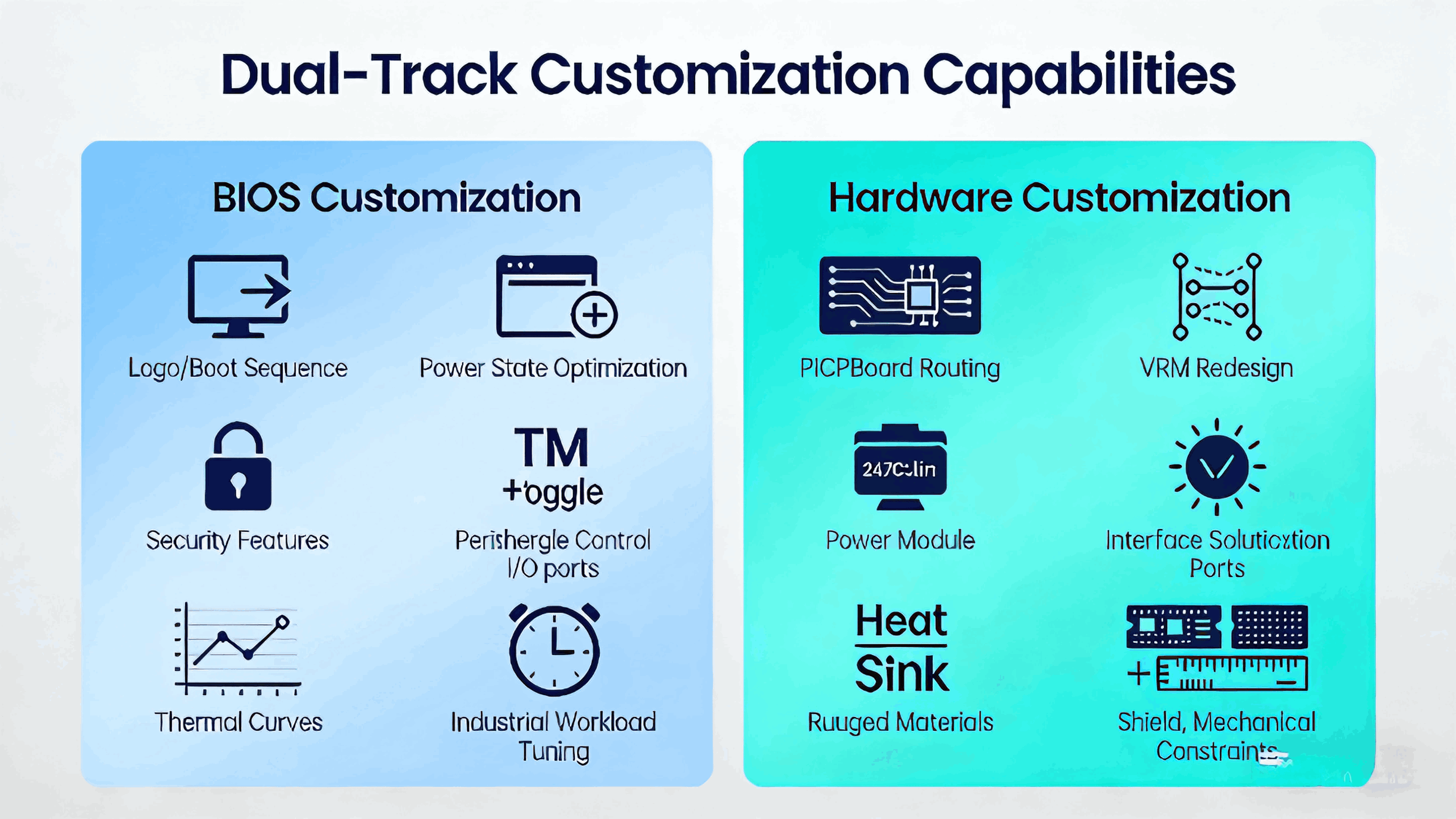
3. Prototype Design & BIOS Customization (DVT Stage)
Our hardware and BIOS engineers start parallel workstreams:
BIOS Customization:
Logo changes, boot sequence adjustments
Power state optimization (S3/S4/S5)
Security features (TPM, Secure Boot, write protection)
Peripheral enable/disable mapping
Custom thermal/fan curves
Industrial or 24/7 workload tuning
Hardware Customization:
PCB re-routing
VRM redesign
Interface/port customization
Thermal solution refinement
Special materials / ruggedization
Deliverables:
4. Validation, Stress Testing & Compatibility Check
This is where many suppliers cut corners—but Angxun does not.
Using our five advanced SMT lines, high-precision SPI, AOI, and reliability equipment, we perform:
Deliverable: DVT Validation Report
Purpose: Ensure the design survives real-world, 24/7 workloads.
5. Pilot Run (PVT Stage)
We initiate a small production batch (100–500 units):
Line setup validation
Material quality verification
BIOS flashing & QC integration
Packaging and labeling tests
Lifetime and repeatability check
Deliverable: PVT Output Report
This stage ensures the design is ready for large-scale production.
6. Mass Production (MP Stage)
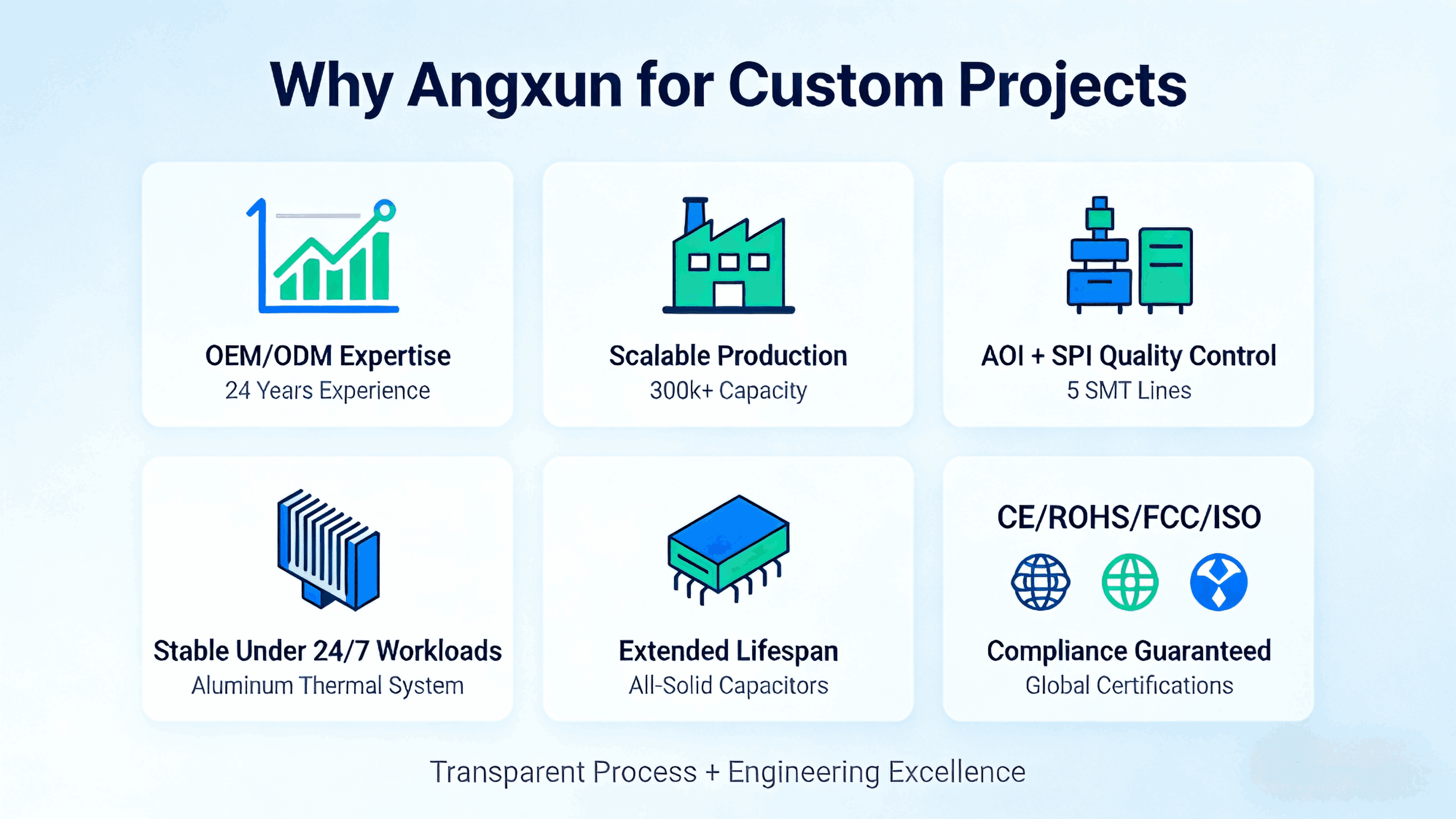
With 10,000 m² facility and 300,000+ motherboard monthly capacity, Angxun scales fast and reliably.
Five SMT lines produce consistent output
AOI + SPI ensure traceable quality
BIOS is locked, version-controlled, and archived
Full QC, burn-in, and sampling inspection applied
Deliverable: Mass Production Units + Final Documentation Pack
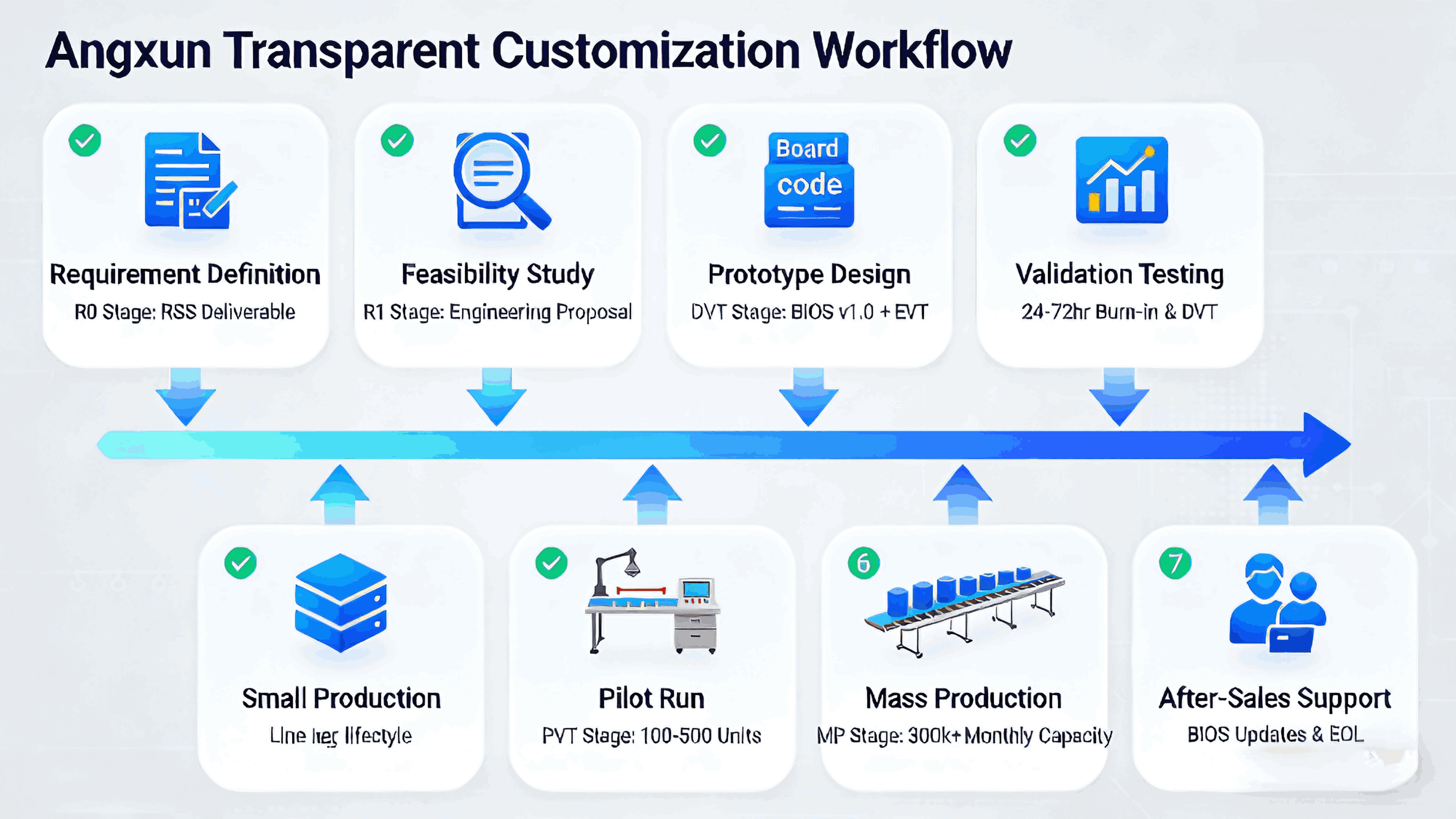
7. After-Sales Support & Lifecycle Management
Customization doesn't end at shipment.
Angxun provides:
BIOS update maintenance
Long-term component lifecycle management
EOL notifications
Technical support for driver/OS updates
Rapid replacement for critical deployments
This ensures your customized solution remains stable for years, not months.
Why Angxun Is Trusted for Custom BIOS & Hardware Projects
Company Strength
24 years OEM/ODM experience
10,000 m² factory & 500+ staff
300,000+ motherboard monthly capacity
5 advanced SMT lines
Eco-environment certified materials
CE / RoHS / FCC / ISO certifications
Product Engineering Advantages
Aluminum-based thermal cooling system
All-solid capacitors for long lifespan
PCB copper plating technology
Independent CPU power supply
Zero-burning protection circuit
Dual safety voltage/current stabilizers
These engineering features directly improve reliability for custom solutions.
Customization Should Not Be a Black Box—It Should Be a Competitive Advantage
A transparent process eliminates fear.
<p line="Kq38" class="ql-direction-ltr ql-long-96991899" ql-global-para="true" linespacing="150" style